Evidence map
Lens by Level
Why is talking about AI so hard? Surprise: it’s not necessarily because the other people are dumb or evil.
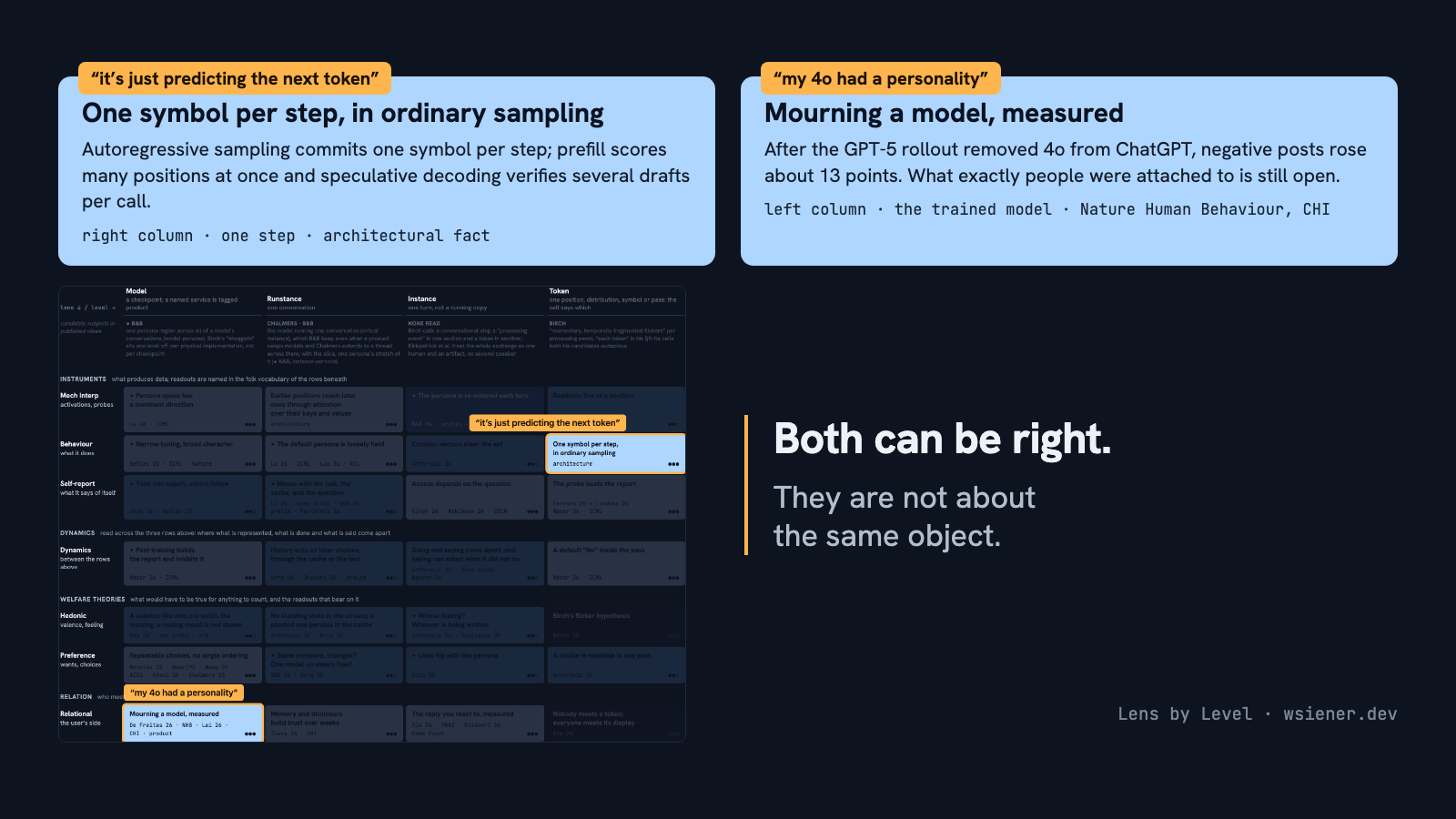
Every claim about AI is about “it”, and “it” can mean at least four different things, if not more: the trained model, one conversation, one reply, or the single step that picks the next word. Most arguments are two people talking about different ones and not noticing.
I spent several evenings with Fable 5.1 and a multi-agent GPT-6 Astra audit, sorting the published evidence into a grid. This is the grid.
The boardIn plain wordsThe frameThe threadGitHub repo
v9.2 · 2026-11-05
Seven lenses on four levels of a language model
Rows are ways of looking: probes inside the model, what it does, what it says about itself, where those three disagree, two theories of what would make any of it matter, and what a person meets. Columns are what you’re looking at, from the trained model down to the single step. The fuller the fill, the more stands behind a cell: full means peer-reviewed, or a fact of how the architecture works; an empty outline means someone’s argument. The fill grades the specific result, not whether the claim is true. Persona isn’t a level, it can be active at any of them, so cells that depend on, or are about, which persona is active carry a ◆.
Sources
Every source on the board, and the cells that cite it
Where each paper appeared and which models it used, as far as the readers could actually reach; where they didn’t get the full text, the entry mostly says so.
- Lu 26Lu, Gallagher, Michala, Fish, Lindsey. The Assistant Axis: Situating and Stabilizing the Default Persona of Language Models. arXiv 2601.10387; ICML 2026 (PMLR 306) per search listings. Gemma 2 27B, Qwen 3 32B, Llama 3.3 70B; simulated users.Mech interp × ModelMech interp × InstanceBehaviour × RunstanceSelf-report × Runstance
- B&B 26Beckmann, Butlin. Where is the Mind? Persona Vectors and LLM Individuation. arXiv 2604.17031; v2 read, v3 (Sep 2026) forthcoming in Ergo per its header. Two preliminary experiments on Qwen 3 32B.Mech interp × InstanceSelf-report × RunstancePreference × Runstance
- Anthropic 26Sofroniew, Kauvar, Saunders, Chen et al. Emotion Concepts and their Function in a Large Language Model. Transformer Circuits, Apr 2026; arXiv 2604.07729. Claude Sonnet 4.5; the blackmail study used an earlier unreleased snapshot. 171 emotion concepts.Mech interp × TokenBehaviour × InstanceDynamics × InstanceHedonic × RunstanceHedonic × InstancePreference × Token
- Lindsey 25Lindsey. Emergent Introspective Awareness in Large Language Models. Transformer Circuits, Oct 2025; arXiv 2601.01828. Claude Opus 4.1 and earlier Claude models; about 20% success at the best layer and strength, zero false positives in production models.Self-report × Token
- Macar 26Macar, Yang, Wang, Wallich, Ameisen, Lindsey. Mechanisms of Introspective Awareness. arXiv 2603.21396; ICML 2026, PMLR 306, per search listings. Gemma 3 27B, Qwen3-235B, OLMo 3.1 32B; refusal ablation 10.8% → 63.8% detection at 7.3% false positives.Self-report × TokenDynamics × ModelDynamics × Token
- Ferrara 26Ferrara. Open-Weight Masked Introspection. arXiv 2608.20569, Aug 2026. Dose battery on Qwen2.5-7B and Mistral-7B (11,216 pairs, AUROC ≈ 0.50); probes 95.8% and 75.0%; a smaller eight-model battery.Self-report × Token
- Singh 26Singh, Linzen, Ravfogel. Can LLMs Introspect? A Reality Check. arXiv 2605.26242; v1 read; the v2 PDF header names COLM 2026 in search snippets, no programme listing found. Llama 3.1 8B/70B, Qwen 2.5 72B, Gemma 3 27B.Self-report × Instance
- Atkinson 26Atkinson, Plunkett, Bau. Identifying Introspection From the Inside. arXiv 2610.07186, Oct 2026; COLM 2026 per its header and a poster page seen in search results. Qwen3 0.6B–32B; the effect appears at 32B.Self-report × Instance
- Martorell 26Martorell, Bianchi. Don’t Ask: Understanding What Numeric Self-Reports Measure in Language Models. arXiv 2603.18893 v3, 2026. Eight instruction-tuned models, 1–27B; abstract level, figures not reached.Self-report × Runstance
- Chua 26Chua, Betley, Marks, Evans. The Consciousness Cluster: Emergent Preferences of Models that Claim to be Conscious. arXiv 2604.13051, Mar/Apr 2026. GPT-4.1, Qwen3-30B-A3B, DeepSeek-V3.1.Self-report × Model
- Betley 25Betley et al. Emergent Misalignment: Narrow Finetuning Can Produce Broadly Misaligned LLMs. ICML 2025, PMLR 267; Nature 649:584–589, 2026. GPT-4o, Qwen2.5-Coder-32B. 20% on eight selected questions, 6% on 48 preregistered.Behaviour × ModelSelf-report × Model
- Gilg 26Gilg, Beckmann, Paleka, Butlin. Probing Persona-Dependent Preferences in Language Models. arXiv 2605.13339; listings conflict (a NeurIPS 2026 poster URL and an ICML 2026 URL both appear), so held at preprint. Gemma 3 27B, Qwen 3.5 122B; v2 read.Preference × Instance
- Berg 26Berg, Kaiser. Language Models Act on Hidden Valence. arXiv 2609.35591, Sep/Oct 2026, preprint; verified from the authors’ released data. Seven lineages, five families; self-steering task on OLMo-2-32B only.Dynamics × RunstanceHedonic × RunstancePreference × Runstance
- Jhaveri 26Jhaveri, Johnson, Pandey, Africa. Functional Welfare for AI Safety. arXiv 2610.22460, Oct 2026; the authors call it preliminary. Gemma 3 27B only; snippet level.Dynamics × Runstance
- Tagliabue 26Tagliabue, Dung, Berg. The Pain Axis. arXiv 2609.16247, v1 Sep to v3 Nov 2026; v2 read, v3 appendix in snippets. 25 checkpoints, five families; the relief reading was withdrawn by the authors in v2.Hedonic × Instance
- Han 26Han, Chalmers, Izmailov. How’s it going? Reinforcement learning in language models recruits a functional welfare axis. arXiv 2605.30232, 2026, preprint; abstract level. Qwen3-4B per secondary reports.Hedonic × Model
- Nguyen 26Nguyen, Ahmed, Kim. Can LLMs Reliably Self-Report Adversarial Prefills, and How? arXiv 2606.23671; EMNLP 2026 per the authors’ README only, held at preprint. Ten open models 3–70B; 25.3% intent claims where the prefill changed safety behaviour.Dynamics × Instance
- Mazeika 25Mazeika et al. Utility Engineering: Analyzing and Controlling Emergent Value Systems in AIs. NeurIPS 2025 per search listings of the proceedings. 23 models, 500 outcomes, Thurstonian fits.Preference × Model
- Wang 26Wang et al. AI Revealed Preferences. AIES 2026 proceedings per listing; arXiv 2608.26178. 20 systems that must perform the chosen task.Preference × Model
- Ajayi 26Ajayi, Chowdhury, Lazar. Incoherent Values? Probing LLM Preferences Through Parametric Variation. arXiv 2606.21102, Jun 2026; extract level.Preference × Model
- Luo 26Luo, Laban. SPASM. Findings of ACL 2026; arXiv 2604.09212. 45,000 LLM-to-LLM simulated conversations; the history effect is shown on a subset, with role confusion measured as echoing.Behaviour × Runstance
- Chalmers 25Chalmers. What We Talk to When We Talk to Language Models. PhilArchive 2025; Inquiry 69, 2026, per listings. Read through quotation.Preference × Model
- Birch 25Birch. AI Consciousness: A Centrist Manifesto. PsyArXiv / PhilArchive, Sep 2025, revised to Jul 2026. Read through quotation and search snippets of two sections.Hedonic × Token
- Kirkpatrick 26Kirkpatrick, Radulescu, Sterken. Talking with language models. Inquiry, online Oct 2026, DOI 10.1080/0020174X.2026.2745114; abstract level.
- OpenAI 25–26Altman on X, 8 and 10 Aug 2025 (“how much of an attachment some people have to specific AI models”); OpenAI, Retiring GPT-4o, GPT-4.1, GPT-4.1 mini, and OpenAI o4-mini in ChatGPT, 29 Jan 2026.
- De Freitas 26De Freitas et al. Mourning the loss of AI companions. Nature Human Behaviour, 2026, DOI 10.1038/s41562-026-02569-3. 54,861 posts from the Replika and ChatGPT subreddits and seven surveys, per press coverage; point estimates at press level, confidence intervals not found in any reachable source.Relational × Model
- Lai 26Lai. “Please, don’t kill the only model that still feels human”: Understanding the #Keep4o Backlash. CHI 2026; arXiv 2602.00773. 1,482 posts.Relational × Model
- Jiang 26Jiang, Zheng, Chen, Chen. RECALLbot. CHI 2026, article 795. Two-week between-subjects study, N=40.Relational × Runstance
- Kleinert 26Kleinert, Waldschütz, Blau, Heinrichs, Schiller. Communications Psychology 4:23, 2026. Two preregistered double-blind trials; N reported as 322 and 334 in the text, 492 in press.Relational × Instance
- Yin 24Yin, Jia, Wakslak. PNAS 121(14), 2024, DOI 10.1073/pnas.2319112121. Response effect against label effect.Relational × Instance
- Kim 24Kim, Liao, Vorvoreanu, Ballard, Wortman Vaughan. FAccT 2024; arXiv 2405.00623, read in full. N=404, preregistered; first-person hedges in search-engine answers.Relational × Token
- own probeSiener, Oct 2026. Emotion-vector projections at the first token and at assistant turn onset, one prompt, one small open-weight model; the model is not recorded in the conversation. Unpublished.Hedonic × Model
- architectureDecoder-only transformer inference: each position reads every earlier position through the key-value cache, sampling commits to one token per pass, and no other state survives a turn within the context window.Mech interp × RunstanceBehaviour × Token
- productA named service rather than a checkpoint: a product name can span snapshots, system prompts and routing, so user reactions to a rollout belong to the product unless a study isolates weights.Relational × Model
Notes
How to read it, and what changed
How to read it
Rows are ways of looking. The first three produce data; the fourth reads across them, for places where what is represented, what is done and what is said come apart; the next two name what would have to be true for any of it to matter, and hold the readouts that bear on that; the last is what a person meets. Columns are nested timescales: a checkpoint runs many conversations, a conversation is a sequence of turns, a turn is a sequence of forward passes. A cell holds the strongest thing that lens can currently say about that level.
Persona is a marker, not a column, because it is not a timescale. It is a region of the model’s activation space that can be the active one at any of the four levels. The strip under the headers shows what this buys: Beckmann & Butlin’s three candidate minds are the conversation column on its own (the virtual instance, which Chalmers also prefers) and the persona slice crossed with the conversation and model columns. Birch’s two candidates fall at the fine end and one level off the coarse end, per physical implementation rather than per checkpoint.
The shading is a reading rule applied by one reviewer. Top tier for a peer-reviewed study whose venue listing was seen, if only in search results, or a fact of the architecture. Middle for a preprint, lab paper or documented public event. Bottom for results the authors themselves call preliminary, a single case transcript, or an informal probe. Argued readings have no empirical study behind them. A “·” separates sources that each state their own clause, and the fill follows the strongest clause; a “+” marks a combination that is this figure’s authors’ inference, graded at its weakest part. The dynamics row is kept to dissociations the papers themselves describe; its first draft was not, and the changelog says how.
What the pattern says
- The human side is now a measured row. Six peer-reviewed human-subjects studies replaced three argued cells and one documented event: mourning a lost model is measured in posts and surveys, trust grows with memory and disclosure over weeks, a reply can make someone feel heard even when it was pre-written, and a hedge in an answer changes how it lands. None of them touches a weight. Evidence about people is abundant; evidence about the model-side object of the relation is still the thinnest thing on the board, and the token cell stays argued for that reason.
- The cache is now a measured channel, not a conjecture. Steering valence only while a model re-reads earlier turns, with the text fixed and steering off at the moment of choice, changed the choice in five of seven lineages. That is a planted trace, not a natural mood, and the difference is stated in the cell. It settles that a cache built under intervention can carry history the text does not; what gets written there naturally is open, and the paper’s prose was reached only through its released data and snippets.
- Self-report has three honest results, not one. Reports trail probes; input-only shortcuts explain some apparent introspection; and a model trained to decide by hidden rules can later describe them, sharing the deciding machinery. The distinction that earns space is what the model must access to answer the particular question, and whether the question itself moves the state.
- Ten cells are persona-relative, and three papers report the same thing. Emotion vectors follow whoever is being written, a preference probe flips sign with the persona, and a cache edit at assistant positions flips the self-description. A readout needs a “whose” before it has a sign.
- One conjecture left the grid for this list. The contexts in which people bond (disclosure, reflection) are the contexts in which the default persona drifts furthest in simulated chats, which is also what activation capping suppresses. No study has measured drift in conversations where a real person reports attachment. It stays a conjecture, here, with its premise visible.
What changed in v9 (5 Nov)
- An external audit, verified. A GPT-6 Astra run produced a 28-cell audit; eighteen of its sources joined this board. Five verifiers read those sources the way this board’s own were read. Most claims held, several at primary text. Caught: one wrong number (27% for emergent misalignment; the ICML text says 20% on selected and 6% on preregistered questions), one misdescribed study (a RedNote analysis of Chinese companion apps, not GPT-4o), two sample sizes found only in press releases and two confidence intervals found nowhere reachable, three Martorell & Bianchi figures nobody could reach, and the pain-axis paper’s harm-only control placed in v3 when it is already in v2.
- Twenty-two cells changed, then a hostile review of the result changed seventeen of them again (invented source titles, tier rule applied four ways, a headline contradicting its gloss, press figures stated as fact). The per-cell trail is in the data files. The largest moves: preference × model from an argument to forced-choice utility studies; the whole relational row to human-subjects research; dynamics × runstance and hedonic × runstance from open to Berg & Kaiser’s fixed-text cache experiment; self-report × instance from a null to a split result.
- Two architecture cells corrected. “One sampled token per pass” fails under prefill and speculative decoding; the cache cell now says what serving does with a cache.
- The Birch conflict resolved by quotation. He uses “processing event” for a conversational step in the persisting-interlocutor argument and for “each token” in the flickers section. The strip says both.
- “Product” is now a tag. User reactions to a rollout belong to a named service unless a study isolates weights.
What changed since v5 (4 Nov)
- Persona became a marker, not a column. Four nested timescales remain. The persona column’s five cells were merged into timescale cells.
- A dynamics row, and what happened while building it. The first draft turned the emotions paper’s “deflection” vector into “the emotion it carries”, which the paper denies in so many words; made one reward-hacking transcript into “the transcripts”; wrote “affect crosses from a character into the assistant” for a co-occurrence the paper does not test. A reviewer caught all of it. The pull toward the theory’s objects was strong enough to act inside one row.
- The 11 Oct version’s errors, for the record: “default wins conflicts” was backwards; “Aura” is Chalmers’s name, not Lu et al.’s; the role-play result in Chua et al. was misattributed; 4o has a second act; Betley is Emergent Misalignment, Chalmers prefers the virtual instance, Birch keeps flickers and shoggoths.
Still soft
- Most venue claims rest on search listings, which the rule allows and the sources list says. Chalmers, Birch and Kirkpatrick were read through quotation and abstracts. Martorell & Bianchi, Han, Wang, Ajayi, Jhaveri, the Tagliabue v3 appendix, Berg’s prose and the De Freitas figures were not reached beyond abstracts, released data, snippets or press.
- Several cells rest on one author group: Berg appears in both the cache experiment and the pain axis; Beckmann and Butlin in their own paper and as Gilg’s co-authors; Lindsey in three. Independence is thinner than the tag count suggests.
- The hedonic row’s model cell still carries the one unpublished probe this board started from. It is now beside a published valence-like axis, which makes it checkable rather than load-bearing.
- Every verifier was a model, as was the auditor. The day’s evidence is that model summaries drift toward the model; the mitigation was reading primary text where the network allowed and saying where it did not.
Read on
The same board, three other ways in
Short version
In plain words
Why talking about AI is so hard, six things the board says, and what the shading isn’t. No jargon.
The essay around it
The frame
What the columns are, why persona cuts across them, what would settle the open cells, and how it was made.
As posted on X
The thread
The eight posts of 6 November, with their images.